

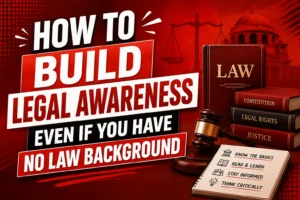
How to Build Legal Awareness Even If You Have No Law Background
How to Build Legal Awareness Even If You Have No Law Background
Every CLAT aspirant coming from a non-law background runs into the same confusing message. The Consortium says no prior legal knowledge is required. Coaching materials say legal awareness will help. Both statements are true at the same time, and that contradiction is exactly what makes this topic confusing rather than simple.
The truth is that CLAT doesn’t test what you’ve memorized about law. It tests how comfortably you move through legal language, structure, and reasoning when you encounter it for the first time in an exam hall. Legal awareness isn’t a body of knowledge you need to acquire it’s a familiarity you build so that legal material stops feeling foreign.
What “No Prior Knowledge” Actually Means for Your Preparation
The Legal Reasoning section supplies every principle a student needs inside the passage itself. In that sense, the Consortium’s claim is accurate nobody is expected to walk in already knowing tort law or constitutional provisions. But there’s a difference between not needing to know something and not needing any exposure to it at all.
Someone reading legal language for the first time will naturally move through a 450-word passage slower than someone who’s seen it before. They’ll pause on words like “vicarious,” “presumption,” or “estoppel,” even when the passage defines the concept clearly enough to answer the question. That hesitation costs time, and in an exam built around passage-heavy sections, time is the resource students can least afford to lose. Legal awareness, then, isn’t about knowing legal answers in advance it’s about removing the friction of unfamiliar language so a student can focus entirely on reasoning.
Start With Everyday Legal Situations, Not Legal Textbooks
The fastest way to build this familiarity isn’t picking up a law textbook. It’s noticing legal structure in situations that are already part of daily life a rental agreement, a warranty on a phone, a news story about a court ruling. Each of these involves a rule being applied to a specific set of facts, which is precisely the pattern CLAT tests.
A useful habit is picking one everyday legal situation a week and working out, informally, what “rule” is actually being applied. If a warranty says a product will be replaced “if defective within one year,” ask what counts as a defect, what “within one year” actually protects, and where the boundaries of that rule sit. This kind of low-stakes practice trains the same instinct that Legal Reasoning passages demand, without requiring any formal legal study.
Read Judgments as Stories, Not as Case Law
Students often feel intimidated by landmark judgments simply because they expect dense, hard-to-follow legal text.. But most well-written summaries of important cases read more like a short story than a legal document: here’s what happened, here’s what each side argued, here’s what the court decided and why. Reading two or three such summaries a month not to memorize facts, but to notice how a court moves from facts to a principle to a conclusion builds exactly the reasoning pattern CLAT rewards.
The goal isn’t to be able to cite these cases later. It’s to become comfortable with the shape of legal reasoning itself: fact, rule, application, conclusion. Once that shape feels familiar, unfamiliar CLAT passages stop feeling unfamiliar.
Let Current Affairs Do Double Duty
Students preparing for CLAT already read the news for the General Knowledge section. That same habit can be redirected slightly to build legal awareness at no extra cost in time. Instead of only noting what happened in a story, spend an extra minute asking what legal or constitutional question is underneath it a policy debate, a rights conflict, a regulatory dispute.
This doesn’t require reading legal news specifically. Ordinary news stories about government decisions, disputes, or new regulations almost always have a legal question buried inside them, and learning to spot that question is itself a form of legal awareness.
Don’t Confuse Vocabulary With Understanding
A common trap for non-law students is building a glossary of legal terms and assuming that counts as legal awareness. It doesn’t. Knowing that “negligence” means a failure to take reasonable care is far less useful than being able to recognize negligence-like reasoning inside an unfamiliar passage. Vocabulary is a starting point, not the destination. The real skill is pattern recognition noticing when a fact situation resembles a rule you’ve seen applied before, even if the specific words are different.
Conclusion
Building legal awareness without a law background isn’t about racing to catch up on legal knowledge before the exam. It’s about steadily removing unfamiliarity with legal language, with the shape of legal reasoning, and with how rules apply to facts so that none of it slows you down when the exam actually tests your reasoning. Everyday legal situations, judgment summaries, and a slightly redirected current affairs habit are enough to build this over time, without ever opening a law textbook. For a structured approach that builds this alongside the rest of your CLAT preparation, explore Abhyaas Law Prep’s CLAT coaching programs at lawprep.in.